Namibia

On culture, heritage & community at Wilderness Doro Nawas

Our Collective

Merryn Haller

7/21/2026

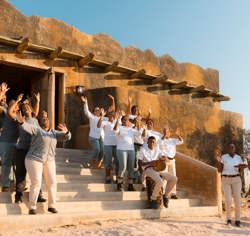
A Doro Nawas camp waiter, on leave for the week, collects firewood to take back to his village. A woman sits beside a dirt road, selling wood carvings of animals to passersby. Two guides greet each other like old friends, exchanging words in Damara. A farmer pauses his tending of goats to wave you down a mountain pass.


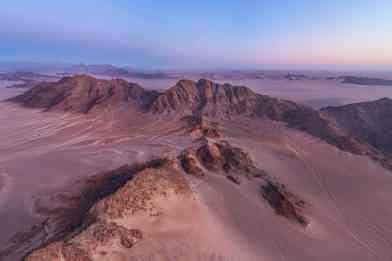
While in private reserves, one hardly sees other people, there’s a warmth to community-owned land like the Doro !Nawas Conservancy*. Villages are few and far between, spread out across the 400,000-hectare landscape, but there is a social fabric that gives both the camp and the conservancy depth. 


Amongst the desert-adapted elephants, ancient rock art and wide-open spaces, there are rich human stories. There is the story of the Doro !Nawas Conservancy, the story of the Damara people, who have lived here for thousands of years or longer, and of the San hunter-gatherers who carved and painted stories of their lives across Damaraland.


That connection to the region’s cultural memory is one of the most grounding qualities of Doro Nawas.


*The ! in ‘Doro !Nawas’ indicates a specific click sound used in the local Damara language.

The Doro !Nawas Conservancy – a community affair


The Doro !Nawas Conservancy was one of the first in Namibia. A groundbreaking model at the time, it gave local communities ownership over what was previously government land. It enabled better access to employment opportunities and allowed communities to reap the financial benefits of wildlife tourism. The conservancy was able to reinvest that revenue into economic development and community empowerment. The same families, some indigenous Damara people, could remain where they had lived and worked for generations. 


Doro Nawas Head Guide Atan Gawiseb, a Damara man himself, works closely with the conservancy as a member of the #Aodaman Traditional Authority, a role he inherited from his father. Traditional Authorities are a critical part of communal conservancies, representing community interests, upholding customary law, preserving traditions, and co-governing with the conservancy to ensure the sustainable use of natural resources. 


‘We are doing extremely well,’ he tells me, naming all the Doro Nawas staff members who were trained up and employed thanks to the opportunities the conservancy and Wilderness provide. 


General Manager Agnes Bezuidenhout echoes this sentiment: ‘At the end of the day, I can say I work for my own community,’ she says. Born in the neighbouring Torra Conservancy, now living in the nearby village of Rendewout, Agnes tells me about her pride in her job since starting with Wilderness as a waitress and general worker in 1996. ‘I like to tell my staff to look at me and how far I’ve come. I tell them they can follow in my footsteps,’ she says. 


Doro Nawas’ staff are a community in their own right. Many of them have worked here for decades. ‘It’s like a family,’ Agnes tells me. ‘The guests can feel that. People ask about our lives, our history, they even ask for us by name before they decide to visit,’ she says. 


Back in 2020, when Assistant Manager Sanni Uiras was pregnant with her first daughter, she met a guest who, over the years, became a close friend. So close, in fact, that she named her daughter after her, and the two remain in touch to this day. ‘This is my home,’ Sanni tells me. ‘I could never go anywhere else. I’m part of the furniture.’ 

An enduring legacy – Damara Living Museum

‘Little is known about the Damaras,’ Atan tells me as we follow the dusty road to the Damara Living Museum. ‘We don’t know from where they came. But when people found the San in Namibia, they also found us.’ 


When the Europeans arrived in Namibia, they met a group of hunter-gatherers and pastoralists skilled in crafts and weapons making, a semi-nomadic people who spoke a Khoekhoegowab language, like the San, but in their own dialect of Damara. 


Displaced first by Nama and Herero tribes in the nineteenth century, then by German and South African colonial rule, the Damara people were forced to trade their ancestral homelands in Central Namibia for the northern semi-desert that is Damaraland, with much of their traditional culture lost along the way. Except for here, at the Damaraland Living Museum. 


‘My relative started this place,’ Atan tells me. ‘It keeps the culture alive. I myself want to bring my children so they can learn about themselves.’ 


Museum guide Cherrien Geirises greets us and ushers us into the entryway. On the other side is a recreation of a traditional Damara village, with a circular arrangement of mud and mopane huts, each with a defined purpose. 


First, the smithery, where a young man dressed in traditional attire demonstrates how small daggers were made. Then the ‘pharmacy’, where we learn about age-old medicinal plant uses. We’re shown how goat hides were stripped and dried to make into clothing or leather toys, how jewellery was crafted out of ostrich shell, and the process of making Holy Fire. Our hosts, men and women from Damaraland’s conservancies, speak only in Damara during the demonstrations, and Cherrien translates into English.


But perhaps the most interesting demonstration was the one that required no translation, as was the case with the traditional game of ||Gus. The board is made up of four rows of stone indents, each with a rock inside. Two rows are yours, two are your opponents, with the aim of taking as many of their rocks as possible. The mechanics, obscure at first, become clearer as we played mostly on instinct, Cherrien gently taking the rocks from our hands when we inevitably made mistakes. Eventually, we found ourselves enjoying the game wordlessly, a group of people from different parts of the world communicating, however flawed, in a common language. 


The San heritage of Twyfelfontein

The San carved petroglyphs which survive to this day at Twyfelfontein, a UNESCO World Heritage Site and Namibia’s first national monument. In the Huab River basin, surrounded by towering sandstone cliffs, the site contains some 6 000-year-old etchings of San men and women next to oryx, ostrich, giraffes and elephants. 


As our Heritage Council guide Elizabeth tells us, ‘We think these were like blackboards for the San to show their children different animals. Maybe the children did engravings themselves. You see some elephants look very accurate, and some – not so much.’ 


Other engravings seem out of place, with animals like rhino and wildebeest – which don’t occur today in this part of Damaraland – making appearances on the rock. ‘But the San were nomadic’ Elizabeth reminds us. ‘Maybe these engravings show rhinos that were once here, or maybe the San saw these animals in Etosha and came back here to document.’ 


Then there are the unrecognisable engravings: mysterious circles, dots and spirals with no clear meaning. ‘These could be maps of water sources; that’s one theory, or they could be spiritual symbols,’ says Elizabeth. 


Twyfelfontein is believed to have been a ritual centre for the San, where shamans would have engaged in religious practices, entering trance-like states, engaging in rain-making ceremonies and initiations. Circles and spirals could be symbolic of spiritual transformation, or they could be a record of the visions shamans saw while in trance states. With no San people living in the area today, who knows what happened here 6 000 years ago? In Elizabeth’s words ‘All we can do is imagine’ – a statement which reminds me yet again of the importance of preserving cultural memory. 

Bridging cultures

As a proud member of the conservancy, and someone with deep roots in Damaraland, Atan sees himself as a cultural ambassador as well as a guide. ‘I want people to understand it,’ he tells me, ‘about the conservancies, the Damara, and all the ethnic groups.’ 


He takes time laying out the history of the Land of the Brave, drawing a map in the sand and indicating where each ethnic group comes from. The Caprivians, Kavangos, Ovambos, and OvaHimba and Hereros from the north, the German Namibians, San, Basters and Hai//oms from Central Namibia, the Nama from the south, as well as the Tswana, Riemvasmakers, mixed Europeans and Afrikaners. Atan describes how each group fits into the story of Namibia. 


As a member of the Traditional Authority, he’s fiercely protective, too, tutting and shaking his head when he sees other operators off-roading. He’s one of only a few allowed to take guests through Twyfelfontein without a Heritage Council guide. He knows things about the landscape only a resident could. For one: the location of a set of rock paintings outside of Twyfelfontein. 


‘The other operators won’t know’ he chuckles conspiratorially over dinner. ‘We who live here, only we know’ he tells me. The next day, he sets out to prove his point. Driving through the rocky hills of the conservancy, we eventually reach a cathedral of boulders where Atan slows to a stop. 


Not a single soul is there except for myself and Atan, who casually approaches the rocks with me following behind. ‘Here we go’ he says, gesturing to the underside of a weathered rock. On it, faint but undeniable, are paintings of San warriors standing over a headless animal. 


‘Are these as old as those in Twyfelfontein?’ I ask, shocked by our privileged access to the paintings. ‘Hmph, maybe older’ he shrugs, ‘maybe older’. His nonchalance fascinates me. 


Atan contextualises what we’re looking out, telling the story of a successful hunt – San women gathered to prepare oryx for an evening meal. He explains how the artists likely chose their canvases carefully, selecting ones with concave surfaces that would be protected from rainfall. He tells me about the shades of white in the rock, too, which indicate that these boulders were carried here by a great flood millions of years ago. He tells me of massive dunes that becomes fossilised over millennia, standing now as ancient rocks around Twyfelfontein’s basin. 


When future archaeologists find relics of today, one can only hope that they’ll also find people like Atan. People with roots here who can say, almost with certainty, what life was in Damaraland was once like. I like to picture the great-great grandchildren of people like Agnes, Elizabeth, Cherrien, Sanni and Atan telling their stories, passing down wisdom, and keeping their own family legacies alive. 


One of the great privileges of travel is being able to exist in the present moment. But Wilderness Doro Nawas’ most moving attribute is its steadfast connection to the past. Those two worlds, constantly in conversation with each other, make Doro Nawas resonate.  


Wilderness Doro Nawas

Explore the camp

More to discover

Embark on another journey through Earth's ultimate, untamed places. These stories capture the raw beauty, passionate conservation efforts, and unique experiences that define Wilderness. We've handpicked these articles to deepen your connection with the wild and inspire your next adventure.
Read them here
The male lion is the king of the Wilderness

Let’s plan your next journey

Ready?

When we say we’re there every step of the way, we mean it, literally. From planning the perfect circuit, to private inter-camp transfers on Wilderness Air, and easing you through Customs. We’re with you on the ground, at your side, 24-7, from start to finish. Ready to take the road less travelled? Contact our Travel Designers to plan an unforgettable journey.